A discussion on ausbiz with Mugunthan Siva and Andrew Geoghegan, about India’s positioning in an environment where global trade discussions dominate the headlines. Is its local demand driven economy, keeping it out of the limelight for now? Also, we discuss Mahindra & Mahindra, one of India’s most successful conglomerates, who is delving deeply into AI across its businesses – Automotive, Tractors, Technology and Financial Services. The company is an astute way to play the India story – and has delivered close to 4x in return since the pandemic. Click Here To Watch The Video

Archive for 2025


Adding “Quality” to your portfolio
- indiaavenueinvest
- June 10, 2025
- 0 Comments
Source: MSCI, each country is represented by the broad country MSCI index, data as of 22/05/2025 The Indian equity market as a whole, possesses all the attributes of a quality stock. We discuss why! Setting the stage India’s equity market continues to distinguish itself globally as a fertile landscape for high-quality businesses. For long-term investors, it presents a compelling combination of structural economic growth and resilient corporate fundamentals—essential ingredients for sustainable compounding returns. In previous articles, we’ve explored India’s long-term growth trajectory, characterised by strong economic expansion and low volatility, as well as the robust earnings profile of its listed companies (Harnessing India’s Growth and A High-Quality Asset at a Cheap Price). In this piece, we turn our attention to another hallmark of India’s equity market—its impressive return-on-equity (ROE) and disciplined use of debt. Over the past two decades, Indian companies have consistently delivered average ROEs above 15%, outperforming their global counterparts. Importantly, this strong performance has not come on the back of financial leverage. Unlike many companies in developed markets that rely heavily on debt to enhance returns, India’s top corporates generate high returns through operational efficiency and organic growth. Source: MSCI, each country is represented by the broad country MSCI index, data as of 22/05/2025 Corporate debt levels in India remain relatively conservative. This prudence reflects the strength of domestic consumption, global competitiveness, and disciplined capital allocation—factors that support sustainable growth without the risks associated with high leverage. Case study: Bajaj Finance A standout example is Bajaj Finance. Over the past decade, the company’s share price has increased by more than 2000%, equating to an annualised return of 113.9%. This performance is underpinned by consistently high earnings quality—average EPS growth of 36.0%, a stable net profit margin of 22.2%, and ROEs of 15% or more. Source: Trendlyne, data as of 22/05/2025 Source: Trendlyne, data as of 22/05/2025 Aside from its pristine fundamentals, Bajaj Finance’s success also reflects the broader shifts in India’s financial ecosystem, including increasing formalisation, digital infrastructure growth, and rising household participation in formal financial markets. Where to next? India remains one of the world’s fastest-growing major economies. Its expanding middle class, urbanisation, and digital adoption continue to provide fertile ground for quality companies to grow sustainably. For investors focused on active stock selection, India offers the potential to uncover tomorrow’s market leaders—companies like Bajaj Finance that combine strong fundamentals with long-term growth potential. Click Here To Read The Complete Article

How India is positioning itself amidst trade turbulences
- indiaavenueinvest
- June 10, 2025
- 0 Comments
Key points: Mugunthan Siva talks US-India trade talks & $120bn UK deal. Positive Indian economic signs: low inflation, tax cuts, urban consumption rise. Optimistic tech sector outlook amid AI focus; India’s growth potential emphasised. Mugunthan Siva from India Avenue Investment shares that trade talks between the US and India are constructive, although timelines remain uncertain. Narendra Modi’s visit to the US and JD Vance’s trip to India highlight improving relations. India also strikes a $120 billion trade deal with the UK. Mugunthan notes that the Indian economy is showing positive signs, with inflation at a low point and potential cash rate reductions. Upcoming personal tax cuts and promising monsoon forecasts could boost urban consumption, benefiting the restaurant, banking, and non-bank financial sectors. In the tech sector, Mugunthan observes slowed deal activity and underperforming stocks. However, optimism grows for AI integration and digital platforms. As markets recover selectively, focus shifts to companies sustaining earnings growth. India’s economic message emphasises significant growth potential amid global challenges. Click Here To Watch The Video

India’s untaped potential amidst trade tensions
- indiaavenueinvest
- April 30, 2025
- 0 Comments
Mugunthan Siva from India Avenue says that India’s trade with the US, currently at $90 billion, might see gains due to potential free trade agreements. Talks have been positive, with India potentially benefiting from less competition from China. Mugunthan suggests India may emerge strong by capturing more market share globally, particularly in sectors like pharmaceuticals and IT services. The country could become a low-cost producer amid shifting trade dynamics, with Apple increasing production there. On Australia-India trade relations, Mugunthan notes untapped potential, especially in agriculture, IT services, and education. With previous minimal trade, leaders have discussed expanding this relationship, offering growth opportunities for both nations. Click Here To Watch The Video

How one active ETF is tapping into the world’s fastest-growing workforce
- indiaavenueinvest
- April 30, 2025
- 0 Comments
How one active ETF is tapping into the world’s fastest-growing workforce Discover how this new active fund unlocks growth in a booming economy driven by unique demographics and local market insight. India: Home to 1.4 billion people, with an average age of 29 – an extraordinary demographic figure, particularly compared to the Western world’s ageing population. The stage has been set for a dominant workforce and a significant consumer. By the end of this decade, 25% of the global workforce will be of Indian origin. Its large and growing stock market is now the fourth largest in the world (only behind the US, China and Japan) with approximately 45% of the market owned by local founders and family structures. These fascinating stats position the region as an unfolding growth story. But how can we, as investors, harness its potential? I sat down with Mugunthan Siva, co-founder and CIO of boutique investment firm India Avenue, and asked him to tell us more about why a group of ex-ING employees cut loose to use their combined experience and network to focus solely on India as a single investment region. Watch the video to learn more about this emerging market and how India Avenue’s new fund (CBOE: IAEF) helps investors easily access the region. Please note, this interview was filmed on 8 April, 2025. Founded in 2015, India Avenue was born from a simple but powerful idea: bring deep insight, experience, and access to one of the world’s most exciting growth markets to Australian and New Zealand investors. “We set up our first fund in 2016… fast forward to today, we manage around $165 million and have just launched an active ETF,” says Siva. Beyond the top 50 on the index While many global and emerging market funds stick to the large caps, India Avenue takes a different path. “The secret to investing in this market is actually finding some of those growth stories further down in the mid and small caps,” Siva explains. Most fund managers focus on the top 50 stocks. But according to Siva, the real opportunity lies in the next tier, where smaller companies often grow faster than the economy and can offer outsized returns for those willing to dig deeper. A young and vibrant population, a dominant global workforce One of the most compelling aspects of this region is the sheer scale and youth of the population. “By the end of this decade, 25% of the global workforce will be of Indian origin,” says Siva. “Even a modest increase in wealth could have a profound impact.” This demographic wave underpins a long-term growth story that touches every sector—from consumer goods to healthcare to financial services. A local lens as leverage India Avenue’s investment strategy is underpinned by local expertise and relationships, something Siva believes is non-negotiable when it comes to accessing this market effectively. “You can only get this exposure through building a strong network on the ground,” he says. The firm has built a dual presence, with a team in Australia to tell the story to local investors, and deep connections in India that include local asset managers, brokers, regulators, and company executives. This network enables them to filter 6,000 listed companies down to a curated portfolio of around 70 names. Managing the risks Investing in a single emerging market does come with its own set of risks – currency volatility, political uncertainty, regulatory complexity, and corporate governance, to name a few. But Siva argues that these risks can be mitigated through knowledge and strong local relationships. “You really need to have a deep understanding of the business ethics… whether they want to grow the business or just fill their pockets,” he notes. Their due diligence goes beyond financials; engaging with peers, suppliers, consumers, and employees to form a comprehensive view of each business. Portfolio positioning For investors wondering where this fits into their overall strategy, Siva is clear: this is a growth-focused, long-term allocation best suited for wealth accumulation. “It’s not really an income-producing or high-yielding asset—it’s more about capital gains,” he explains. Given its low correlation with the Australian market and a different currency exposure, it can also offer diversification benefits to a traditional portfolio. For more information, visit the India Avenue fund page on their website, or on Cboe. India Avenue’s Active ETF gives investors an easy and convenient way to harness India’s growth story, with exposure to 60-80 companies listed on Indian stock exchanges, in one listed security. Click Here To Read The Complete Article
EM investment opportunities amidst disruption
- admin
- April 25, 2025
- 0 Comments
EM investment opportunities amidst disruption Kenneth Andrade from Old Bridge Capital Management and Mugunthan Siva from India Avenue Investment Management share insights on the emerging market opportunities in India. They observe a pullback in Indian equities, prompting a focus on sectors like pharmaceuticals, communications, and aviation. Kenneth notes India’s manufacturing capabilities are expanding beyond domestic needs, echoing past successes in IT and pharma. The upcoming expiration of drug patents, worth $465 billion, represents a significant opportunity for Indian pharma to disrupt the GLP-1 drug sector and biosimilars market. Click Here To Watch The Video
Capitalising on India (Part I)
- indiaavenueinvest
- April 17, 2025
- 0 Comments
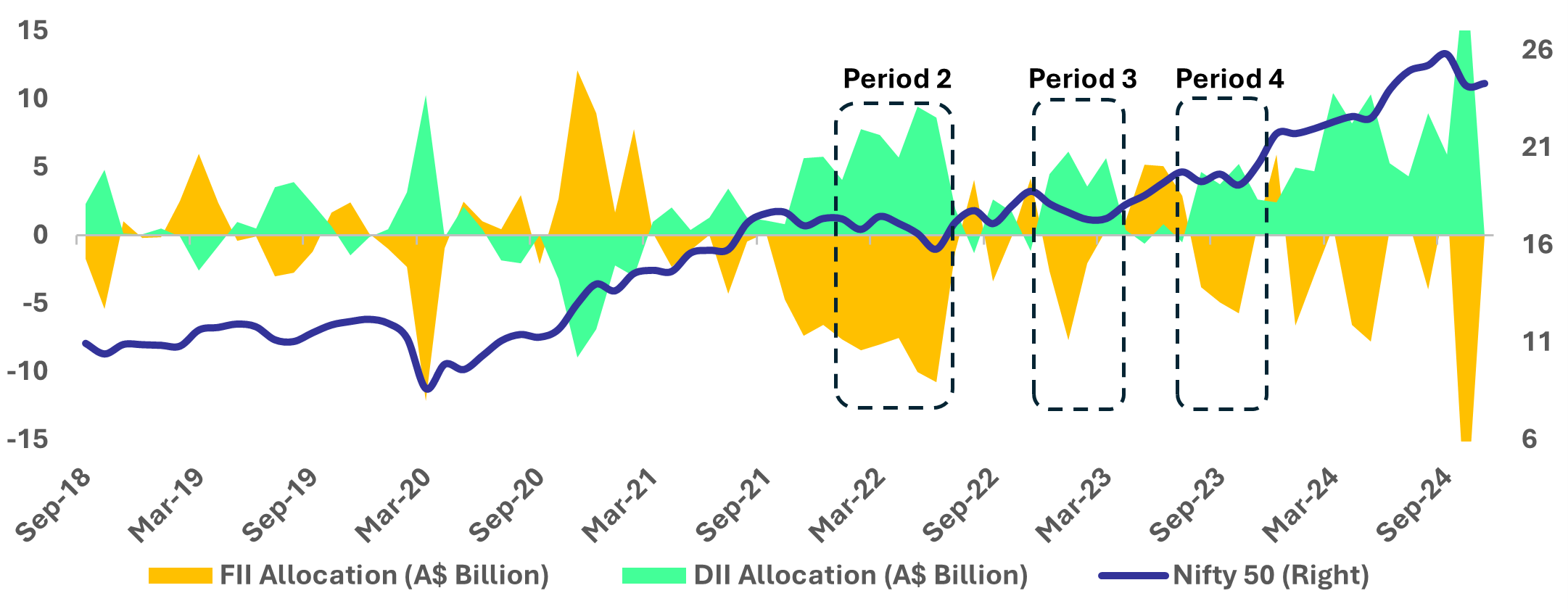
Capitalising on India (Part I) India’s growth story is only mid to early cycle. Playing it the right way will make a significant impact to portfolios. The Best Way to Invest in India India, as the fourth-largest financial market and one of the world’s fastest-growing economies, presents an undeniably compelling opportunity for investors. To fully capitalise on this growth story, it is essential to strategically invest in Indian stocks to maximise returns. We propose that three critical factors can guide investors in achieving this objective effectively. In this note, we discuss the first of the key factors. Stay Invested: Structural Over Tactical To evaluate the performance of staying invested versus tactical trading in the Indian stock market, we analysed the contrasting approaches of the two primary investor groups: foreign and domestic investors. Foreign investors, including Foreign Institutional Investors (FIIs) and Foreign Portfolio Investors (FPIs), have historically favoured a tactical approach over a structural one in India. This strategy has often led to missed opportunities in this high-growth market, as their activities primarily revolve around short-term tactical beta plays rather than long-term commitments to structural allocations. Typically, EM and Asia Funds (a large component of FII//FPI investors) tend to play India more tactically, switching between over and underweight. In contrast, Domestic Institutional Investors (DIIs) in India have evolved into “rupee cost averaging” through monthly investment plans via their local mutual fund. In CY2024 alone, local investors invested over US$60bn, into their own market! By studying the timing and impact of FII entries and exits and comparing their strategies with those of DIIs, we aim to highlight key differences. Using historical data on allocations and the performance of the Nifty 50 index, we assess how effectively FII strategies leverage—or stray from—market opportunities. Nifty Performance vs FII and DII Net Allocation Period Net Flows and Subsequent Performance Period FII Allocation A$bn DII Allocation A$bn Subsequent 12m Performance 1. Feb20 – Apr20 -15.5 13.3 69% 2. Feb22 – Jun22 -25.6 22.5 16% 3. Dec22 – Apr23 -9.4 15.4 34% 4. Aug23 – Dec23 -9.9 11.6 11% (YTD) Source: Motilal Oswal (Bulls & Bears), NSE, data as of 31/10/2024 FII’s often reduce their exposure during market downturns, frequently missing out on the recovery gains that follow. In contrast, DIIs tend to increase their allocations during these periods, providing market stability. Historical data highlights that during significant market declines, DII inflows typically counterbalance FII outflows, with the Nifty 50 index often rebounding thereafter. However, FIIs commonly re-enter at higher market levels, reflecting suboptimal timing and forfeiting substantial gains from post-recovery rallies. This pattern underscores the advantages of adopting a structural, long-term allocation strategy over a tactical rebalancing approach. A consistent investment strategy, akin to that of domestic investors, allows for better alignment with India’s enduring growth trajectory and the potential for enhanced alpha generation. The compounding benefits of long-term investments play out across market cycles, rewarding those who stay invested. However, behavioural challenges often deter foreign investors from re-entering markets at higher levels after selling, further emphasising the need for a more disciplined, cycle-agnostic approach. Click Here To Read The Complete Article

India decoupling with discipline
- admin
- April 16, 2025
- 0 Comments
Emerging Markets India Avenue Investment Management’s Mugunthan Siva comments on India’s equity performance, noting its resilience amidst global markets. India’s reliance on local demand rather than exports positions it uniquely as global tariffs fluctuate. The central bank’s rate cuts may bolster the market as inflation stays controlled. Key export industries including pharmaceuticals and IT services face uncertainties due to US tariff considerations. While Indian pharmaceuticals benefit from temporary exemptions, the sector remains cautious, awaiting clarity. Click Here To Watch The Video

How one active ETF is tapping into the world’s fastest-growing workforce
- admin
- April 16, 2025
- 0 Comments
India: Home to 1.4 billion people, with an average age of 29 – an extraordinary demographic figure, particularly compared to the Western world’s ageing population. The stage has been set for a dominant workforce and a significant consumer. By the end of this decade, 25% of the global workforce will be of Indian origin. Its large and growing stock market is now the fourth largest in the world (only behind the US, China and Japan) with approximately 45% of the market owned by local founders and family structures. These fascinating stats position the region as an unfolding growth story. But how can we, as investors, harness its potential? I sat down with Mugunthan Siva, co-founder and CIO of boutique investment firm India Avenue, and asked him to tell us more about why a group of ex-ING employees cut loose to use their combined experience and network to focus solely on India as a single investment region.
Oz Banks have been great, but…..
- admin
- April 16, 2025
- 0 Comments
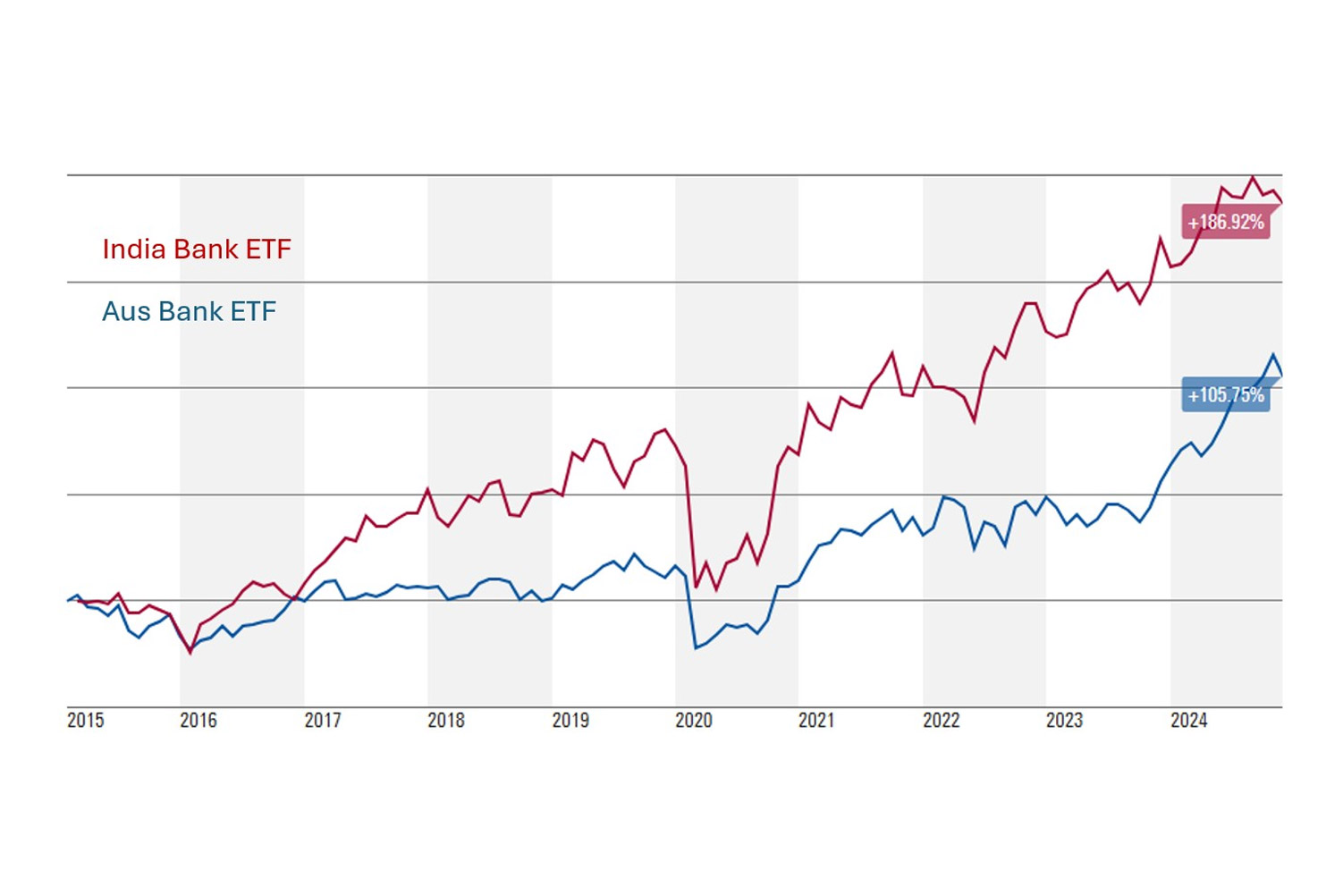
Australian Banks have been the core of every investor’s equity portfolio, but India’s banks have experienced far greater returns! The banking sector serves as a fundamental pillar of any economy, and investors seeking market exposure can assess the conditions of financial stocks across different regions to gauge their economic health and future trajectory. Australian investors tend to favour domestic banks as a key part of their investment portfolio due to their perceived stability, as well as attractive dividends to create wealth. Although this is largely true, we view that investors seeking longer-term growth opportunities in the financial sector should look beyond the local markets as countries in the developing phase can present more attractive growth stories. Click Here To Read The Complete Article