

Introduction
Digitisation is both a social and economic transformation which is far more significant in its impact in a developing economy. The process results in the vast adoption of digital technologies to produce, process, circulate information and is a crucial economic driver in GDP growth and employment creation. India has a significant, young and widespread population and which has access to the lowest cost data in the world, setting the landscape for significant opportunity from digitisation and greater inclusiveness of rural India in the country’s growth story.
There are over 700 million Indian’s who use the internet. Just thinking about that number is mind blowing. However in the context of the 1.4 billion population of India, there are still close to 700 million to go! Internet penetration in the past has been impacted by difficulty of usage, lack of knowledge of benefits, lack of internet access at home and affordability.
The benefits of Digitisation
Digital India was a campaign launched by the Government of India in 2015 in order to ensure the Government’s services are made available to citizens electronically by improved online infrastructure and by increasing Internet connectivity or making the country digitally empowered in the field of technology. It is both enabler and beneficiary of other key Government of India schemes, such as BharatNet, Make in India, Startup India, Standup India, industrial corridors and infrastructure projects. The first major step was the Aadhaar Card, a digital biometric identity card now held by over 1.2 billion people.
The broad aim of the Government was to make India a knowledge economy and improve governance and foster inclusiveness. Some of the reasons for pursuit of digitisation were:
- Nationwide information infrastructure – broadband highways enabling connectivity
- Easier mobile connectivity, public access to the Internet
- IT training for jobs
- Manufacturing of electronics in India (Apple and Samsung now manufacture in India)
- E-Governance improving leakages related to corruption and “middlemen” and improved the audit trail of flow of funds to appropriate sources
- Linking India’s national identity card, banks accounts, subsidy payments
Significant Internet and Mobile Penetration
According to a report published jointly by Internet and Mobile Association of India (IAMAI) and data analytics firm Kantar (1 ICUBE 2021 Report – Internet in India, a study conducted by the IAMAI and KANTAR), internet penetration should increase from here, with users estimated to rise to 900 million by 2025, driven predominantly by growth in rural India. The pace of rural growth was evident from 2017-2021 at 27% p.a., outstripping urban growth at 8% p.a.
Mobile phone penetration has also increased at an incredible rate, with over 1.14 billion wireless subscribers (625 million urban, 516 million rural) by March 20222 . India’s tele-density at the wireless level is now at 83%, driven by urban density at 130% (rural is at 58%). There remains a massive opportunity in rural India for India’s privately owned mobile phone operators (Reliance JIO 35% share, Bharti Airtel 32%, Vodafone Idea 23%, Government owned BSNL 10%).
Digital Transactions Experiencing Strong Growth
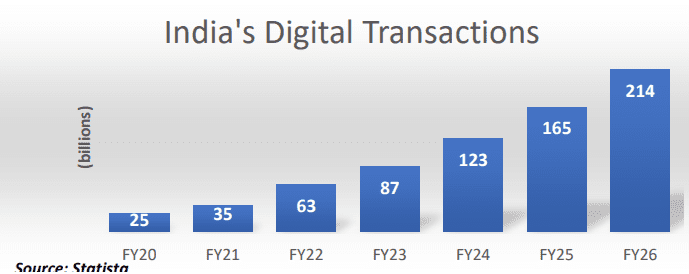
India’s more significant mobile and internet penetration is changing the face of how business is done. IAMAI/Kantar report says around 346 million Indians are engaged in actual online transactions such as e-commerce and digital payments, which is more than the entire population of the United States! This growth has accelerated since the Digital India initiative was launched in 2015 by the Government of India, with a view that digitisation can help overcome physical barriers and costs and could boost the transformation of almost every aspect of governance. In November 2016 the Modi Government also introduced Demonetisation as a reform, which indirectly pushed more transactions from cash-based to digital by tackling the “black economy”. Finally, along came the Covid-19 pandemic, which sparked a 51 percent increase in digital transactions in two years!
Internet usage still growing
Entertainment, communications and social media were the top three activities engaged in by Internet users across India according to the IAMAI/KANTAR report. There are 467 million social media users in India. The penetration of over-the-top (OTT) digital technology platforms i.e. Netflix, Amazon Prime, Disney etc. in rural India is at par with that in urban India, however, the penetration of other digital services such as online gaming, digital commerce and digital payments is still skewed in favour of urban users. This mix will change as rural India has greater connectivity going forward and inclusivity is likely to drive stronger economic and corporate profit growth.
5G to accelerate connectivity and growth
The Government and India’s privately owned telecom service providers are focusing on increasing the internet penetration in India, especially in rural India. The Government recently approved a package of A$30bn to boost ailing state-run telecom service provider BSNL in a bid to help it expand its 4G services to wider catchment areas across rural India. Meanwhile, the more recent 5G spectrum auctions saw a high level of interest.
Outlook
India’s significant population, with an average age of 29 years and its digital ecosystem of having lowest cost data in the world3 , is likely to lead to significant growth for corporates who are increasingly conducting business digitally. This has the potential for rising revenue, increasing efficiency and productivity and enabling significant cost savings. The points below highlight some of the opportunities and growth due to India’s digital transformation:
- India has the second largest number of “unicorns” (a company which was a start-up which is now worth over $1bn) and is only behind the United States (US) in building new unicorns4 , with, several of them relying on a sizeable young population, digital transactions, ecommerce, technology sophistication and low-cost data.
- Foreign direct investment in India continues to rise, particularly targeting businesses driven and supported by technology. In FY22 over US$83bn5 was received, with a significant amount going to computer software and hardware.
- According to McKinsey, digitisation can bring logistics costs down by 20-30% (India having one of the highest logistics cost-to-GDP at 12-14%, compared to the global average of 8%).
We estimate the digitisation of India can add about US$1 trillion to GDP over the course of this decade, which is significant given India is currently a US$3 trillion economy. This will have a profoundly positive impact on India’s economy and its corporates.
Our Disclaimer:
Equity Trustees Limited (“Equity Trustees”) (ABN 46 004 031 298), AFSL 240975, is the Responsible Entity for the India Avenue Equity Fund (“the Fund”). Equity Trustees is a subsidiary of EQT Holdings Limited (ABN 22 607 797 615), a publicly listed company on the Australian Securities Exchange (ASX: EQT). The Investment Manager for the Fund is India Avenue Investment Management Australia Pty. Ltd. (“IAIM”) (ABN 38 604 095 954), AFSL 478233. This publication has been prepared by IAIM to provide you with general information only. In preparing this information, we did not take into account the investment objectives, financial situation or particular needs of any particular person. It is not intended to take the place of professional advice and you should not take action on specific issues in reliance on this information. Neither Equity Trustees, IAIM nor any of their related parties, their employees, or directors, provide any warranty of accuracy or reliability in relation to such information or accept any liability to any person who relies on it. Past performance should not be taken as an indicator of future performance. You should obtain a copy of the Product Disclosure Statement before making a decision about whether to invest in this product.
The India Avenue Equity Fund Target Market Determination is available. India Avenue Equity Fund’s Target Market Determination is available on our website: www.indiaavenueinvest.com/our-fund. A Target Market Determination describes who this financial product is likely to be appropriate for (i.e. the target market), and any conditions around how the product can be distributed to investors. It also describes the events or circumstances where the Target Market Determination for this financial product may need to be reviewed.