
Whilst India, as the world fastest growing major economy, attracts a lot of headlines, it hasn’t yet led to significant investments from Australian and New Zealand based investors as yet. Investors have shied away from the region due to the following reasons:
- Fear of the unknown when investing in emerging markets, like India
- Fascination with US driven themes like AI, Renewable Energy, Commodities
- A lack of investment options
- A strong local property market
However, while India has largely been ignored in Australia and New Zealand (with just over A$1 billion) invested in India-only equity funds and ETF’s, it is likely that interest will rise. Given world leading GDP growth and favourable demographics.
So how exactly do you invest in India? There are multiple ways one can invest to benefit in the economic growth of a region. The most common method, due to simplicity, liquidity and transparency, is by investing in the region’s equity market.
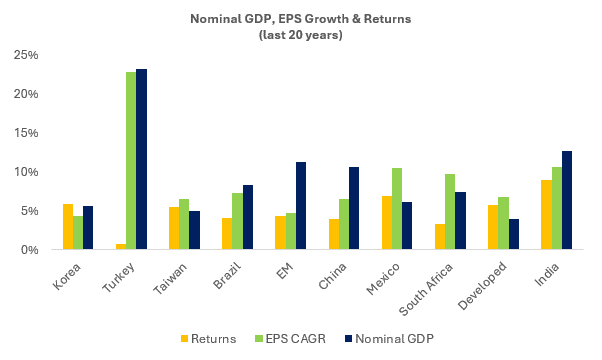
There is some relationship between a country’s economic growth, the corporate profit growth the companies listed on its stock market and investor returns from investing in its equity market, experience. This is generally more likely is an economy which is capitalist in nature and under a democratic regime.
The chart below indicates economic growth (Nominal GDP) and its linkages to company earnings growth (EPS Growth) and equity market returns. Certain regions like India, Korea, Taiwan and Mexico as well as Developed Markets like the US, Europe, Japan have shown a greater relationship between growth and returns.
To take advantage of a country’s economic growth, as we articulated above, the simplest way to get started is by investing in its equity market. The liquidity is the most attractive feature for investors some fear of the unknown. Using the example of investing and benefitting from India’s growth story, one can choose one of the following methods:
Invest in the equity markets of the country like India (India focused Equity Fund or ETF)
This provides exposure to a well-diversified portfolio of listed Indian companies, which should include a mix of already established companies as well as lesser-known names with significant potential. This will allow you to get exposure to more companies in the region and allow for a controlled approach on how much you allocate to India in your overall portfolio.
Invest in a mix of growing economies, which may have a decent allocation to India (Emerging Markets or Asia Fund)
This provides some exposure to listed companies in India and across other developing countries. However, investing in this broader region doesn’t necessarily allow a focused participation in the growth story of an economy like India. The exposure to India is likely to be limited to larger companies which have already been successful and are established. This method makes sense if you feel there are many other growth regions in developing countries than just India.
Invest in a Global Fund which may hold some Indian stocks (Global Equities Fund)
A global fund has a mandate of being able to invest in any region and usually allocates a significant component to the US, Europe and Japan as these regions are large economically and by size of their equity markets. However, allocations to stocks in countries like India tend to be limited to 1 or 2. This method would only be appropriate if you have no particular interest or view specifically on India.
Once you have decided which Fund or ETF you would like to use, it’s pretty simple. You can fill out an application form directly from the firms website or if it’s an ETF, you use your broking account to place a trade via the exchange. If you receive advice from a Financial Adviser, then you should speak to them about how best to implement your investment view, if you want to do so. Financial Advisers quite often implement their financial advice via an investment platform, so the Fund or the ETF would need to be onboarded on that platform.